
Alzheimer’s disease often begins with subtle but profound changes: among the earliest warning signs is spatial disorientation, the inability to recognize routes or recall familiar paths. This symptom can drastically affect independence and quality of life, making early detection essential.

In collaboration with researcher Davide Cammisuli (Airalzh and Università Cattolica di Milano), ComfTech contributed to a pioneering study exploring spatial disorientation in patients with early cognitive decline.
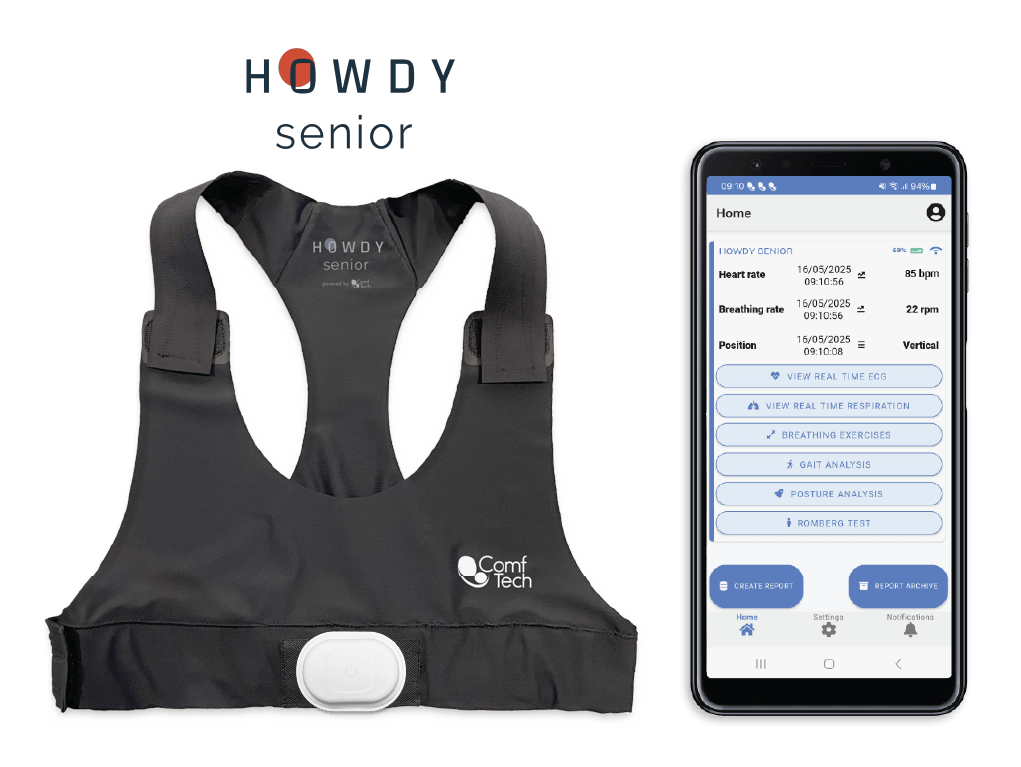
During the trials, participants wore ComfTech’s Howdy Senior, our smart garment equipped with sensors to continuously track physiological and motion parameters — including cardiorespiratory frequency, gait. This allowed researchers to detect moments of hesitation, confusion, or stress during navigational tasks.
Thanks to wearable monitoring, the study provided objective evidence of altered spatial cognition in patients with mild cognitive impairment and Alzheimer’s biomarker.

Beyond research, this technology could evolve into practical tools for caregivers, enabling them to:
- Receive real-time alerts about disorientation episodes
- Monitor physiological responses remotely
- Locate loved ones quickly via integrated GPS
This project reflects ComfTech’s broader mission: integrating wearable into digital health ecosystems. By contributing to cutting-edge research, ComfTech reinforces its role as a trusted partner in advancing personalized, human-centered healthcare.
This is discussed in two articles published by La Repubblica on World Alzheimer’s Day:
- Alzheimer’s: how technology is helping research to combat spatial disorientation in patients https://milano.repubblica.it/cronaca/2025/09/20/news/alzheimer_tecnologia_aiuta_studio_contrastare_disorientamento_spaziale_malati_cammisuli-424858228/amp/
- Alzheimer’s: science turns on the GPS of memories https://www.repubblica.it/salute/2025/09/20/news/alzheimer_la_scienza_accende_il_gps_dei_ricordi_ma_mancano_fondi_e_una_legge_per_l_assistenza-424857149/amp/